
ONE Platform Architecture
ONE as platform for many products
The ONE is a platform for fast developing and running the business rules and templates for the specific customers to generate and publish various types of documents, including but not limited to PDFs, MS Word, MS Excel, HTML, EdgarHTML and more.
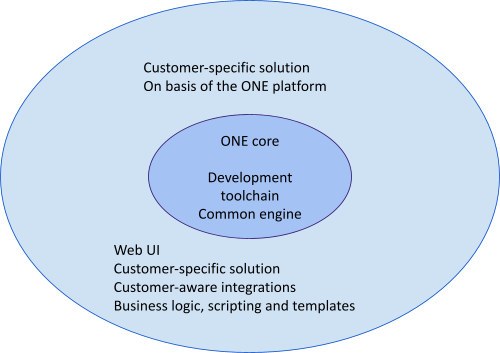
So, it has a platform toolchain for developers, platform runtime, and customized development for every customer individually.
Platform Core
The platform has the two important parts:
- Development time;
- Run time.
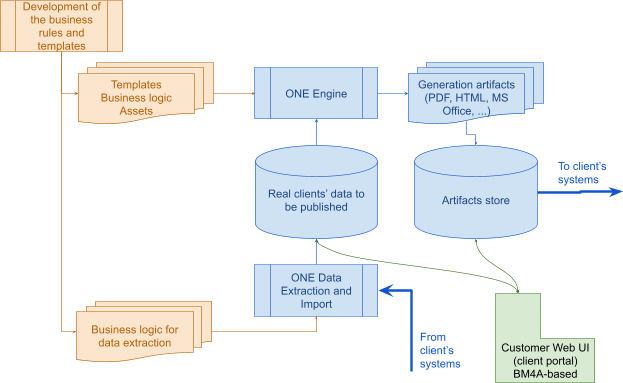
At development time, we’re developing templates and appropriate business rules as part of templates, and we’re using the dev tools to check and execute templates at the development time.
Once the templates are ready, we’re deploying it to the run time components, including but not limited to the data extraction core (to fetch data from 3rd party data sources and files) and execution core, to fetch the collected data and fill it into the templates.
At the same time, we are doing precise business analysis of customer needs to build customized Web UI and perfect client-oriented workflow. Of course, we have our underlying platform to build rapid UI with user-defined dashboards, various types of the reports, and we supply many ready-to-go components like Single-Sign-On, Query tool, File Manager, Job Manager, Users and Roles, and several other standard components to let admins and managers to see all metrics and reports they need.
Platform and client-supplied customization: Structured Notes
Every customization has individual
- Business rules and templates
- Data extraction rules
- Charts
- Client Portal
- Client workflows as part of the Client Portal
- Data Imports
- Client integrations, including SFTP, REST API, WSDL API, 3rd party services, IMAP4, ...
- Possibly platform optimizations and quirks.
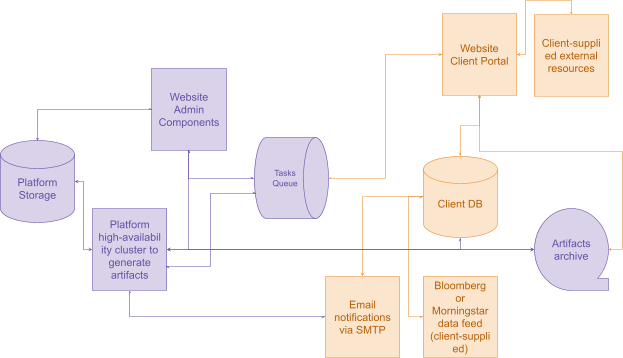
For Security-based solution, it looks like the following diagram:
3rd party software
For certain cases, we need to use 3rd party software or components due to customers’ requests, like Bloomberg or Morningstar data feeds. They are not the parts of the platform as they are necessary for dedicated clients and it needs expensive licenses to run.
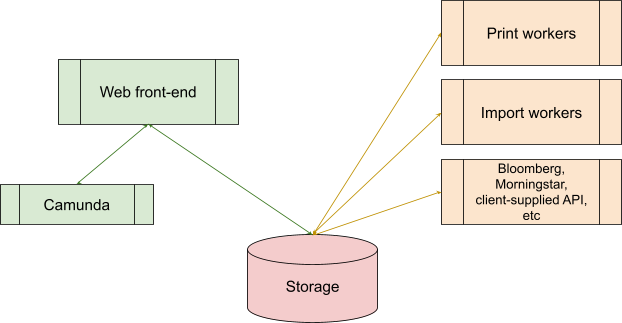
For rapid UI deployment, we’re using the BM4A product.
For Workflow, we’re using Camunda Server (open source, Apache-based).
For identity and access management solutions we are using KeyСloak.